Ants are a common household pest. Taking preventative measures can help repel and eliminate these common invaders over time.
Using white vinegar, borax, essential oils and other household items can help repel and kill ants. However, these DIY methods are not safe for children and pets. Nontoxic commercial repellent sprays may be safer options. Contact Ben’s Pest Control for more details.
Inspect the Outside of Your Home
There are more than 700 species of ants in the United States, and many can be found in and around homes. Ants are highly social insects that work together to forage for food, water, and shelter. As foraging workers discover a new resource, they leave behind a chemical trail that guides other members of the colony to its location. Ants often enter homes through small gaps and cracks in walls, windows, and foundations. Regularly inspecting for ant entry points and sealing them with caulk or weather stripping can prevent these insects from gaining access to the interior of your home.
The most common ant pests that invade homes are pavement ants, odorous house ants, and thief ants. These ants can be frustrating indoor pests because they can quickly spread from one area to another, and they tend to swarm in large numbers. Despite their tiny size, ants can cause extensive damage to property when they invade indoor spaces.
When ants invade the kitchen, they can spread bacteria from their feet to food or dishes and even infect people with certain human pathogens (such as pharaoh ants). Outside, ant infestations may be caused by unprotected bird feeders that provide an attractive source of food for ants, or by rotten sweet fruit and honeydew deposited on plants by aphids or soft scale insect pests.
While ants can be problematic pests, they also do several beneficial tasks in the yard and garden. For example, ants aerate the soil and reduce weed seeds. They also help control the population of pests that feed on grass, such as fire ants. If ant activity becomes a problem, contact a U.S. Pest licensed pest professional for a perimeter treatment that will target the specific ant species invading your property.
To keep ants away from your property, consider trimming the vegetation that grows against your house or building. Plants that brush against your roof or walls can act as ladders for climbing ants, which will then crawl up into windows and doors to enter the home. Also, regularly inspect and remove debris piles that can provide nesting sites for ants.
Create a Repellent Barrier
Ants are notoriously persistent and capable of entering homes through the smallest cracks or crevices. Sealing these entry points is an effective strategy to combat a current infestation as well as prevent future invasions. Performing regular inspections of the home for new gaps and sealing them immediately is also important.
Minimizing food availability in the interior of the home is another key strategy to ant control and prevention. Storing food in airtight containers and sweeping surfaces regularly is essential, as is disposing of garbage frequently and keeping trash bins securely closed. Regularly wiping down countertops and tables and removing food leftovers from plates after eating can also help keep ants away. Similarly, storing pet food in sealed containers and removing uneaten portions from bowls as soon as the pets finish their meals can help deter ant attraction.
Vinegar and other household products can serve as natural repellents for ants. A solution of equal parts vinegar and water in a spray bottle can be applied to ant trails and nests, masking their pheromone scents and inhibiting their ability to navigate the area. Mixing baking soda with water to form a paste and applying it to ant areas can also be effective as a natural ant deterrent.
Peppermint oil can also be used to repel ants, as can neem oil. Mixing undiluted neem oil with cotton balls and placing them in areas where you see ants can serve as a natural, low-cost and effective ant deterrent. Likewise, saturating cotton balls with cinnamon leaf essential oil or trans-cinnamaldehyde (found in neem) and placing them in these same areas can act as an effective ant killer and deterrent.
While these simple, DIY strategies can greatly diminish the allure of the property for ants and significantly improve ant control and prevention, they are not a substitute for professional assistance in the event of a serious infestation. In the event of a major problem, HonorGuard Pest Control is ready to assist with expert identification and proven methods of extermination. Call us for a free consultation to learn how we can help address the issue and safeguard your property.
Apply a Granular Bait
Most ant infestations begin in the outside of homes and are often aided by overgrown shrubs, heavy mulch, or other ground covers that provide cover for the ants. If ants have access to the home, they can also enter through window and door frames, expansion joints, cracks, and eaves. General suppression products, such as sprays and dusts, can be used to reduce ant activity in the yard, but they do not penetrate into nests or affect ants that travel underground.
The best way to keep ants out of structures is by using granular bait. Baits such as InVict Xpress, which contains.5% imidacloprid, lure insects to the treatment area with a food attractant while providing an effective control mechanism. Foraging ants will find the bait, take it back to the colony, and feed it to other members of the ant colony. This will quickly deplete the colony and help prevent re-infestation.
Apply granular bait around the exterior of structures at a rate of 4-8 oz per 200-400 linear feet adjacent to the structure. The bait can be applied by hand, with a granule spreader, or poured into refillable/serviceable bait stations (available from Maxforce Complete). It is important to not spray directly over the granular bait, as this will reduce its effectiveness.
Be sure to follow the product label for specific application rates and instructions. Typically, the bait should be evenly scattered along trails, nest entrances, or in cracks and crevices where ants are active. Using a non-repellent spray prior to applying the bait may enhance its performance and help it achieve quick results by dispersing the insecticide throughout the treatment area.
In addition to using granular baits, it is important to deny ants alternate food sources inside the home by thoroughly cleaning kitchens and other areas where ant foraging occurs. Additionally, leaky faucets or other water sources that supply ants with free water should be fixed.
Another great option for ant control and prevention is to use an odorless liquid or gel ant bait such as Niban, which contains a unique compound that kills ants by disrupting their metabolic process. This is a great alternative to traditional ant pesticides that kill by direct toxicity.
Use a Non-Repellent Spray
If you have tried home remedies and natural solutions like white vinegar, boric acid, coffee grounds or essential oils to no avail, a non-repellent spray is the next step. These products work by smothering the ants and killing them, and can be effective against large infestations of ant species such as Argentine and Odorous house ants. These products are also safer than pesticides.
If an ant colony is large or the infestation includes multiple ant species, baits may be more effective than sprays. For example, a granular insecticide such as lambdastar UltraCap 9.7% or EcoVia G can be applied along the foundation where it meets the ground and around structural joints such as expansion and eaves. It can also be used around windows and door frames, places where cables, pipes and wires enter the building, as well as in kitchen cabinets and medicine cabinets.
The granules are undetectable to foraging ants, which means they can be placed where the ants are most likely to be found. When the ants forage over the treated surfaces they pick up and carry the granules back to their colonies. The ants then consume the granules, spreading them to other members of their nests and killing them. Using this type of product can eliminate the entire ant colony and prevent them from coming into the structure.
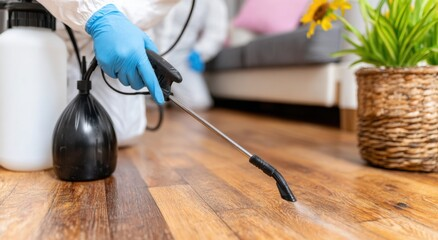
To use a non-repellent product, mix the labeled amount of liquid insecticide with water and apply it using a hand pump or backpack sprayer. Be sure to use a wide enough area to effectively cover the area where you have seen ant activity. If you have not seen any ant activity, you can also apply the product in areas where you want to keep them out such as behind a kitchen sink or near appliances where they may hide.
In addition to sealing cracks and crevices where ants are entering your home, make sure that food is sealed in containers, and crumbs and spills are cleaned up immediately. Fix any leaks and keep garbage cans tightly closed. Keep pet bowls away from areas where food is stored, and don’t leave uncovered food out in the open. By eliminating attractants, and using repellents and granular baits in the right locations, you can eliminate ant infestations and prevent them from recurring.